
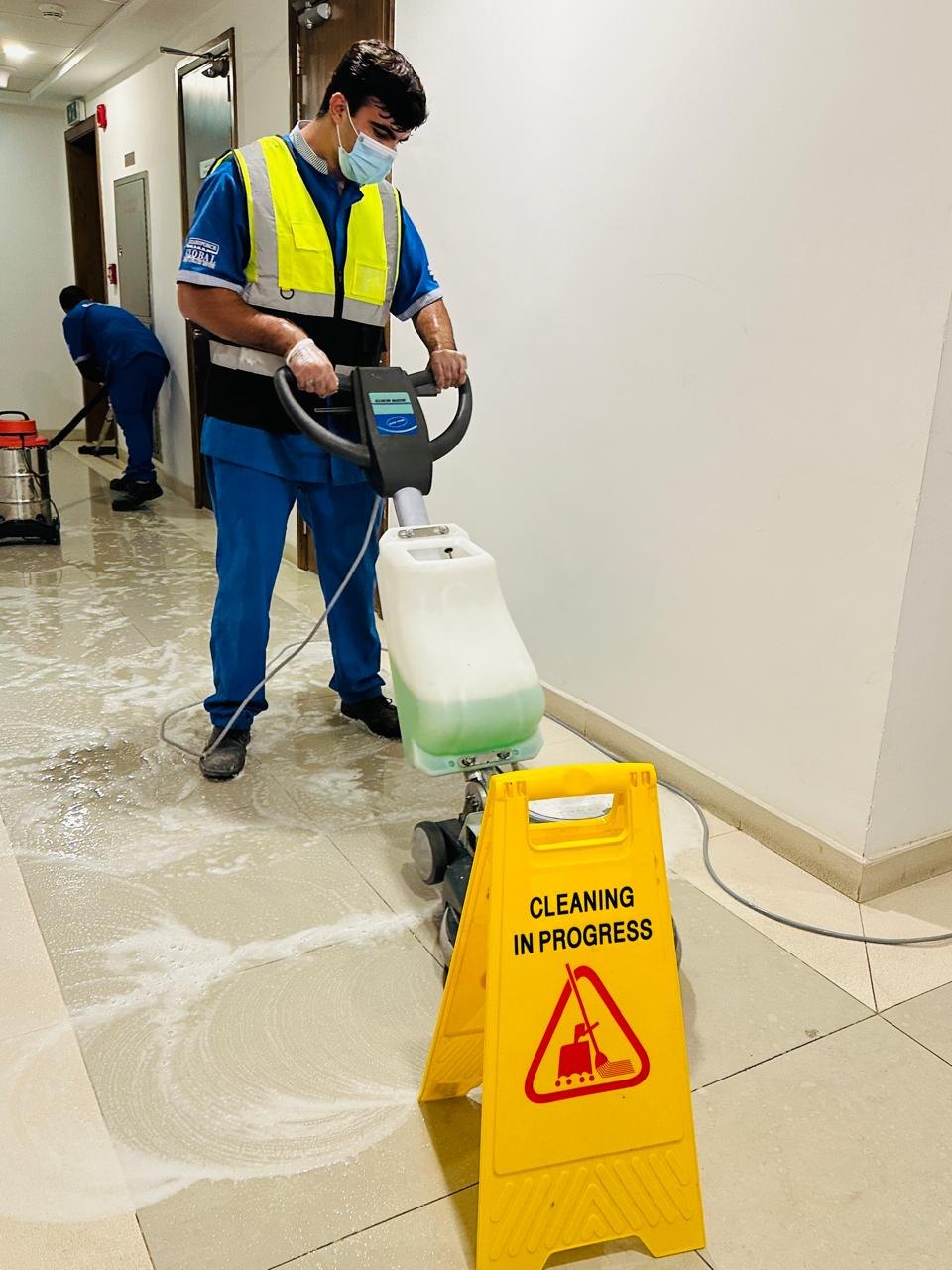
A commercial deep clean should solve a defined site problem, not simply promise a longer version of routine cleaning. For an office, retail premises or shared building area in Dubai, the useful starting point is a site survey: which areas need attention, what condition are they in, and when can the team work without disrupting the business?
This checklist helps facilities managers and procurement teams prepare a brief, compare proposals and agree what a finished job should look like. For the service itself, see MKM Global’s commercial deep cleaning service.
When is a commercial deep clean useful?
Routine cleaning maintains a site at an agreed frequency. A deep clean targets accumulated soil, neglected details or a specific handover standard. Common reasons include a periodic reset, a change of occupier, reopening after a closure, or preparation for an inspection or important visit. A recently fitted-out space may also need a separately assessed clean. Do not assume a standard scope includes construction waste or specialist restoration.
If the underlying issue is that daily standards slip between intensive cleans, consider revising the ongoing commercial cleaning plan and strengthening supervision and inspections.
What to record before requesting a quotation
Give each contractor the same information so you can compare prices and proposed methods fairly:
- Site and zones: location, facility type, approximate floor area, floors, rooms, washrooms, kitchens, circulation spaces and any areas excluded from access.
- Current condition: photographs or a walkthrough showing build-up, stains, marks, high-touch points and surfaces needing special care.
- Surfaces: floor finishes, carpets, upholstery, internal glazing, fixtures and equipment that require manufacturer-approved methods.
- Access and safety: permits, escort rules, occupied areas, sensitive equipment, water and power availability, and safe access to elevated areas.
- Operating window: dates, duty timings, noise restrictions, drying time, handover deadline and who can approve completion.
- Resources: expected staff numbers, any site-specific male and female staffing requirements, and whether MKM or the client will provide chemicals, consumables and equipment.
A site survey and mobilisation discussion is the right place to resolve uncertain quantities or methods. A quote based only on a generic square-metre rate can miss access, surface and scheduling constraints.
Agree the work by zone, not by vague labels
“Deep cleaning throughout” is difficult to inspect or price. Instead, name the zones and tasks. In an office this might include reachable high- and low-level dusting, floor-edge and skirting detail, washroom descaling where appropriate, kitchen degreasing, internal glass and partition cleaning, and attention to doors, switches and other agreed touchpoints. For retail or common areas, the priorities may be entrances, circulation routes, lifts, washrooms and customer-facing surfaces.
During the survey, confirm which treatments suit each surface. Check whether machine cleaning, extraction or specialist products make sense. Test methods where needed, protect nearby furnishings and agree whether the site must remain in use while work is under way.
Write down the exclusions too
Unless the survey and proposal explicitly cover them, do not assume the price includes hazardous waste, pest or mould remediation, repairs, inaccessible high-level work, external façade access, specialist clinical decontamination or a guarantee that a space is sterile. Disinfection, if requested, needs its own risk-based scope and suitable products; ordinary deep cleaning and disinfection are not interchangeable.
Plan staffing, supplies and duty timings
A realistic schedule depends on the site condition, number of zones, access window and equipment. Ask how many people the contractor proposes for each shift and who will supervise them. Check that the plan allows time for setup, safe working, drying and final inspection. If your premises have site-specific staffing or access requirements, state them in the enquiry instead of leaving the contractor to guess.
Also settle who supplies chemicals, consumables and machines. If the client supplies any of these, agree the quantities, product suitability and availability before the start date. Otherwise, missing supplies can delay the job or force a change of method on site.
How to check the result
Before work starts, agree a simple completion record by zone. The site contact and supervisor can inspect representative surfaces together, note areas needing rework and record out-of-scope issues. Photographs can help where the client permits them, but they should not replace an on-site check.
For recurring requirements, use what the deep clean reveals to improve routine frequencies, supervision and consumable planning. A one-off reset has more lasting value when the follow-on cleaning plan protects the standard.
Questions to ask at the site survey
- Which areas are highest priority, and what outcome is expected in each?
- Are there delicate surfaces, restricted rooms or equipment that must not be moved?
- What is the available working window, and when must the site be ready for use?
- Who provides chemicals, consumables, equipment, water and electricity?
- How many staff are likely to be needed, who supervises them and who will sign off the work?
MKM Global plans commercial deep cleaning around the actual premises and operating requirements rather than a one-size-fits-all package. To discuss an office or other business facility in Dubai or elsewhere in the UAE, request a site survey and share the site details, preferred dates and any supply or staffing requirements.